
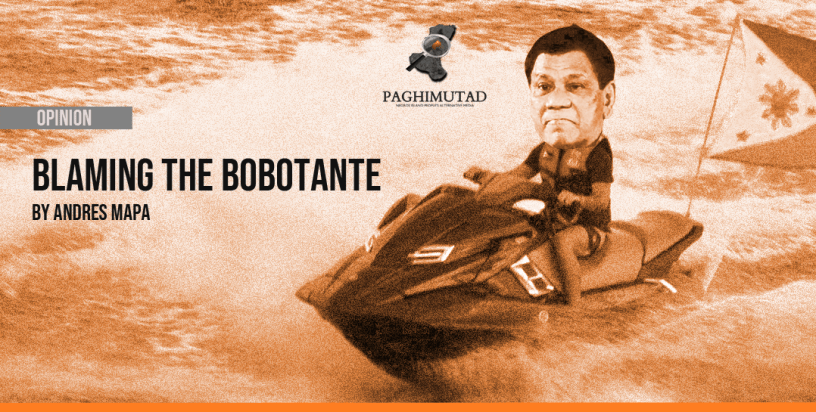
During his 2016 campaign, Duterte told a fisherman he would ride a jetski to Spratlys and plant the Philippine flag there to assert our sovereignty against China’s illegal incursions. Five years later, as tensions in the West Philippine Sea continue to rise, he admitted that that pronouncement was just a “pure campaign joke” and that those who believed in him are “stupid”.
How dare these idiots pin their hopes on a joke? The waves are larger than the seas, and I am afraid of drowning, he says.
In this sweeping admission, he takes his mask off and shows everyone that deep inside he truly is a paper tiger. All bravado and no brawns. But this is not solely a symptom of Duterte’s politics. In fact, this is typical of all bureaucrat capitalists, or politicians who run the government like a business, i.e. to accumulate more capital. They talk tall when wooing the masses and yet quickly lose any pretense of progressiveness once in power. Politicians lie, and Duterte is just too frank about it to a fault.
As we mark a year until the 2022 elections, narratives of the bobotante are starting to gain traction. (For English speakers, bobotante is a wordplay of bobo, meaning stupid, and botante, meaning voter.) The Duterte Die-hard Supporters (DDS) are still being blamed for not knowing any better. Some commentators on the net even say Duterte is not wrong for calling his voters stupid. But voter-blaming simply sprouts from the belief that democracy is simply a cast in the ballot. The rise of Duterte is not just due to the 16 million people who voted for him. In the first place, Duterte’s brand of populism appealed to the majority because of the very failures of the liberal elite’s brand of democracy that he so staunchly opposed during his campaign. Duterte assumed an image counter to the disente politics of the previous Aquino administration.
Moreover, voting is only truly democratic if the state itself is run by the democratic majority, which is the peasantry and the workers. But the reactionary state we have now is merely an instrument of the ruling class. To choose to be blind about the class interest of the state is to deny the limitations of one’s voting power.
In the months leading up to the elections, a truly honest voters education will take this into consideration. Voters’ education efforts should also raise one’s political consciousness. Merely presenting a liberal, seemingly more progressive candidate— that is political campaigning. A voters’ education that conflates the class interest of the politician and that of the masses would be a dangerous lie. Their class interests are diametrically opposed. Despite conceding with piecemeal reforms to appease the public, bureaucrat capitalists want to maintain the status quo, while the toiling masses struggle for genuine change.
To truly empower a voter, one must clarify the anatomy of Philippine politics as a playground of elites. That those who wield political power do so because of their economic power acquired from exploiting the masses. This does not mean that we belittle our constitutionally-enshrined right to vote or the parliamentary struggle. Instead, this would make the voter realize that there is a wider ground for civic engagement beyond the ballot. That after elections one must continue to struggle against anti-poor and fascist policies, and to also unite for reforms that could benefit the masses.
Everyone should go register and vote. But one must always stress that elections are an uneven playground which favors the landlords, imperialist lackeys, and the compradors. We can vote Duterte and his political pawn away come 2022 elections, but imperialism, feudalism, and bureaucrat capitalism will remain to be the ills of our time. Thus, when we “educate” a voter, we also have to enjoin them toward the movement for just and lasting peace, above and beyond sham elections.
###

