
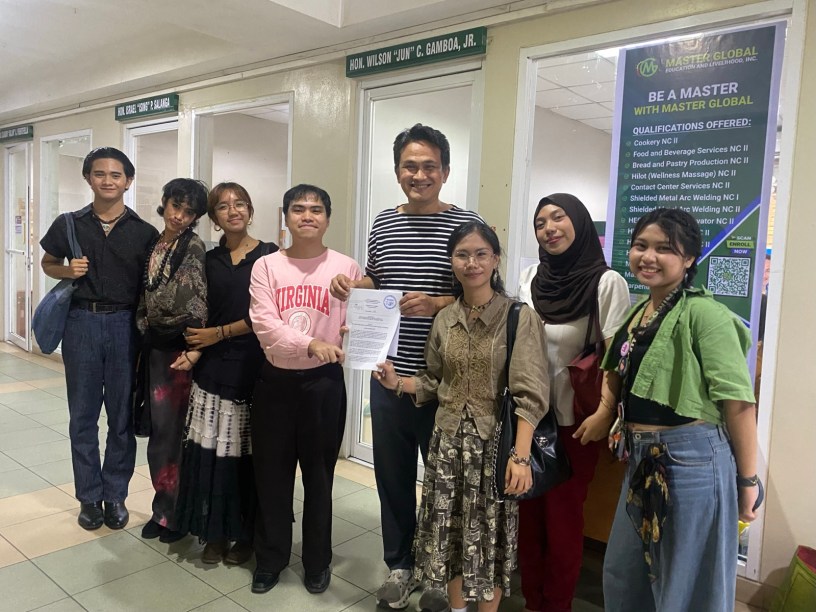
BACOLOD CITY — Kabataan Party-list Negros and the College Editors Guild of the Philippines–Negros Island Region (CEGP-NIR) held a joint dialogue with Bacolod Councilor Wilson Gamboa on July 29 to present the concrete situation and concerns of students and the youth regarding the proposed Research Protection Ordinance currently being pushed in the Bacolod City Council.
Representatives from Kabataan Party-list Negros, campus publications affiliated with CEGP-NIR, and various youth organizations discussed the burdensome process students already undergo to conduct research, community immersion, and other community-based academic activities under existing policies of the Commission on Higher Education (CHED) and the Department of Education (DepEd).
The youth leaders said approvals for community-based activities are already often delayed, affecting academic requirements and organizational initiatives. They warned that the proposed ordinance would further lengthen the process by adding another layer of approval before research and community activities could proceed.
Under the proposed ordinance, researchers and student organizations would first need an endorsement from their educational institution before submitting their proposed community study or activity to the concerned barangay, which would also have the authority to approve or reject the proposal.
According to the youth organizations, this requirement could become a barrier to academic freedom by making research on pressing social issues dependent on additional bureaucratic and political approval. They argued that studies involving controversial community concerns may become vulnerable to delays or denial.
“Dagdag pa nila, maaaring maging balakid ang ordinansa sa kanilang academic freedom na pag-aralan ang mga pinakatampok na isyung panlipunan ngayon.”
The organizations explained that the ordinance’s requirement for educational institutions to endorse community studies and activities before they can be submitted to barangays grants local authorities additional discretion over whether research activities can proceed, potentially limiting students’ ability to conduct independent studies on pressing social issues.
Campus journalists affiliated with CEGP-NIR likewise raised concerns over the ordinance’s possible impact on campus press freedom. They noted that community stories are a regular part of campus journalism and warned that requiring barangay approval could hinder coverage of issues that local officials may find unfavorable.
The organizations also emphasized that the ordinance may discriminate against out-of-school youth organizations and other civic groups that regularly conduct educational discussions, fact-finding missions, and community engagements with marginalized sectors. They argued that requiring institutional endorsements could effectively exclude organizations without formal school affiliations from carrying out legitimate community work.
Kabataan Party-list Negros and CEGP-NIR also directed the public to their position paper, which contains their full analysis of the proposed ordinance and its potential implications for students, youth organizations, and campus journalists.
“Sa pagtatapos ng dialogue ay binigyan ng Kabataan at CEGP-NIR ng kopya si Gamboa ng isinusulong na Students Rights and Welfare Bill, na isinusulong nilang maipasa upang mas komprehensibong maprotektahan ang karapatan ng kabataan, lalo na ang kanilang academic freedom.”
According to the organizations, the dialogue concluded with the formal presentation of House Bill No. 211, or the Students Rights and Welfare Bill, to Gamboa. The measure was introduced by Kabataan Party-list Rep. Renee Louise M. Co and ACT Teachers Party-list Rep. Antonio L. Tinio and seeks to declare the rights and promote the welfare of students by institutionalizing protections for academic freedom, campus press freedom, student organizations, and other fundamental student rights.
The proposed legislation provides a more comprehensive and rights-based approach to protecting students than the proposed Research Protection Ordinance. Gamboa accepted the copy of the bill and expressed his commitment to support and advocate for its consideration in the Bacolod City Council, the organizations said.

