
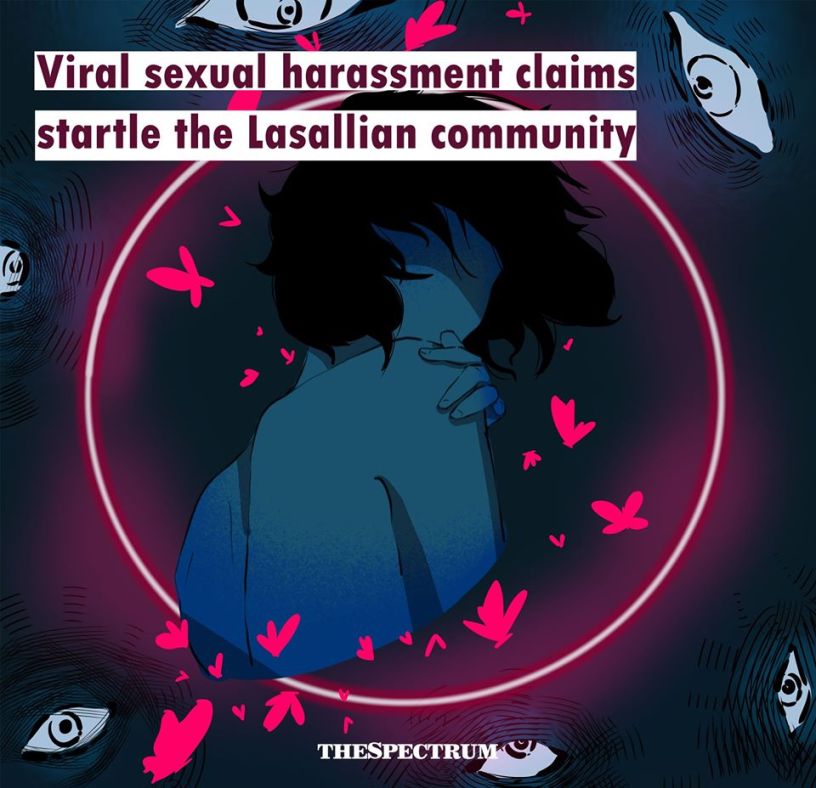
Last June, after a viral #HijaAko movement (or the local #MeToo movement) went viral on twitter, students from multiple schools from around Bacolod started speaking out about their experiences of sexual abuse and harassment online, outing their predators, and breaking the silence of their trauma.
The trend may be attributed to Miriam University students coming out about their stories of abuse and predatory experiences during the schooling, however, Negrosanon students coming out about their own stories started after a “Manyaks of UPV (University of the Philippines-Visayas)” was created in Twitter, prompting one to be created for the University of St. LaSalle – Bacolod.
A few weeks later, dozens of allegations had circulated the social media platforms of Facebook and Twitter. Below is an article written for The Spectrum by Ivee E. Manguilimotan and Joshua L. Mahilum, with reports from Angela A. Coronel, Shan Marc O. Jabagat, and Adrianne H. Saplagio.
Follow The Spectrum – USLS, the official media corps of the University of St. La Salle, for news not only of the institution but also the various plights faced by Negrense students of today.
The Spectrum – Viral Sexual Harassment Claims Startle The LaSallian Community
Recently, a number of students from Liceo De La Salle went online to recall some of their traumatic experiences and alleged some faculty of inappropriate behavior in the senior high school. The posts spread like wildfire on social media as more students shared and commented on the issue.
Hours after the basic education administration released a statement denouncing all forms of harassment and bullying, a screenshot of a Twitter exchange showing Lasallian Br. Irwin Climaco’s “Snowflakes” tweet and Basic Education Principal Br. Francisco “Sockie” de la Rosa’s reply circulated on social media linking it to the online complaints; it generated a backlash.
To shed light on the issue, The Spectrum has obtained a statement from the brother principal and interviewed some officials from the Discipline and Formation Office, Office for Student Affairs, Guidance and Evaluation Center, and the Provincial Council for Women.
Out of context
In a statement, Br. Sockie confirmed the existence of the controversial Twitter conversation between him and Br. Irwin but denied all the claims that tie the tweets to the sexual harassment allegations.
“I had a Twitter exchange with Br. Irwin regarding a personal trait of his. Someone who follows us on Twitter took a screenshot and sent this to another person who, unfortunately, linked it to the allegations of inappropriate behavior and the complaints of victims. To be clear: our exchange had absolutely nothing to do with the allegations of sexual harassment in USLS,” he stated.
Br. Irwin, in a Twitter post last July 4, clarified his controversial tweet earlier saying that it was a personal issue.
“Most of my one-liner tweets [have] to do with my personal struggles. My tweet, “Snowflakes”, is about my personal issue, for I was called [as] such,” Br. Irwin wrote. Urban Dictionary defines a “snowflake” as someone who is easily hurt or offended by the statements or actions of others.
Moreover, the brother principal reiterated that bullying and harassment are not tolerated in the university and that the basic education administration strives to create a safe space campus.
“On the day of having been alerted to allegations of possible inappropriate behavior, I […] immediately set up a committee to look into the recent allegations, offered professional counseling to possible victims, and established an institutional reporting “hotline” for harassed and threatened students on campus or online.
The brother principal revealed that after the hotline was made available, they have received and acted on several complaints alleging some students and teachers of inappropriate behavior.
Furthermore, Br. Sockie raised his concerns on the use of social media as a complaint platform and advised everyone to utilize the established formal grievance mechanisms in the university.
“While social media may serve as a convenient vehicle for ranting and venting, I have serious doubts and concerns about its use in helping achieve justice for the aggrieved. Proper investigation and disposition of justice require due process,” he stressed.
Zero Cases
Liceo De La Salle-Senior High School Discipline and Formation Office (DFO) found the online surge of sexual harassment complaints unexpected since their office recorded zero sexually-oriented cases within the previous academic year.
“It was a surprise that those things came out. Last school
year, there were a lot of students who were sent [here] because of different violations but not harassment,” Liceo DFO Head Gilrey Vocales said.
The head discipline officer, however, pointed out that their jurisdiction is limited only to cases where the people involved are both students.
“The DFO is only handling the students-to-students relationship. If ever we come across a certain faculty being complained of sexual harassment, we’re going to forward it to the Brother President or to the Vice Principal who has jurisdiction over them,” Vocales explained.
Higher Education Unit (HEU) DFO Head Kirk Adrian Koudroglou said it is also the case for the college unit and if the complaint involves a faculty member, it must be brought to the HEU administration.
Moreover, Koudroglou exhorts all Lasallians to always be prudent and cautious when using social media.
“Don’t use the internet as a release [for] your anger or frustration or discontent. There are laws that are in effect that address these actions, conducts, and acts that are done in social media. One way or another, you are going to be committing an offense against somebody else. Apart from being a victim, you are going to be an offender [as well],” the college discipline officer warned.
Action in progress
The Office for Student Affairs Dean Rowela A. Chiu assured the Lasallian community that they are taking action in addressing and investigating the alleged sexual harassment claims.
“We are still looking into this, we are still gathering facts. Rest assured there will be a resolution,” Chiu verified.
Chiu shared that there are administrative policies and provisions observed by the faculty, staff, and administrators which also covers students who seek to redress via the proper channels.
“We don’t close our doors to any complaint or to any student who may be feeling aggrieved. You can always bring it out in the open,” Chiu affirmed.
When asked about the allegations on protecting the school’s reputation, Chiu mentioned that they only want students to be responsible for airing their complaints and directing it to the proper venues.
“We want students to be critical and to be evidence-based. […] We have our voice box, we do our consultations, we have assemblies with your respective deans. We are venues to air out your concerns,” Chiu conferred.
Furthermore, she was grateful that the issue was brought to their attention but she claimed that it would have been better if it was brought to them directly and not through social media.
“Bringing the matter in social media, I guess, will spark alarm, and will cause undue pain to all parties concerned but I don’t see a clear resolution. That is why students [are] to be extra mindful,” Chiu admitted.
In their corner
According to the Guidance and Evaluation Center (GEC), there are students who are victims of sexual harassment that come forward and seek help from their office, although not at an alarming rate.
“Very few usually come forward and tell authorities about it,” GEC Counselor Marijoy Gaduyon explained.
Gaduyon further elaborated that the victim would feel scared and that they would find it hard to report the incident, especially if the perpetrator is around.
“It’s already a big step for anyone who has been sexually harassed to come forward and ask for help,” Gaduyon assured.
She also stated that there are levels of trauma: 20 years old and above can usually handle the fear or trauma reactions from the event while other cases, like minors, who can no longer manage the trauma, are referred to psychiatrists or assisted by parents.
“We are here to see to it that their security and welfare are looked into and given priority. When they come to the office, we provide them with psychological intervention. When the level of trauma is very high that it already affects the person’s normal life […] then that’s the time we work closely with the psychiatrist,” GEC Director Joselito Diaz shared.
In handling the cases where minors are involved, GEC calls the attention of the parents to allow them to have jurisdiction over the situation and can also respond by filing a case against the alleged perpetrator or reporting it to the school administration.
Gaduyon, however, emphasized that they can only help if the victim or friends of the victim seek help from the proper authorities.
“If they know their [students’] rights, then they would know that it is also important for them to find justice and fairness by reporting it to the right venue. Your level of trust in informing the people who can help you is [also] necessary to create the safe space,” Gaduyon stressed.
Legal defenses
In an interview with Provincial Council for Women Adviser Marie June Pavillar-Castro, she explained that sexual harassment used to be described by women as a problem without a name until the passage of the Republic Act (RA) no. 7877 or the Anti-Sexual Harassment Act of 1995, which declared sexual harassment as unlawful in schools, training institutions, and workplaces. In 2019, this was expanded through RA no. 11313, also known as the Safe Spaces Act.
“A victim of sexual harassment can file administrative, civil, and criminal cases against the harasser or perpetrator. The administrative sanctions or penalty depends on the act or gravity of the offense and the [sexual harassment] rules of a school or the workplace,” Castro expanded.
She shared that penalties for perpetrators are heavier if the victims are minors for which parents and/or the Social Welfare Office shall assist minor victims.
Additionally, the filing of cases may vary whether it was reported less than 24 hours after the incident or long after the act was committed.
“If [sexual harassment] incidents can be reported immediately, the perpetrator can be arrested if it is [in] ‘hot pursuit’ or the time of the incident has not lapsed 24 hours. Then [a] case can be filed through inquest proceedings and the suspect cannot go out of jail, especially if it is not bailable,” Castro verified.
However, if reporting is done long after the act was committed: it will have to go through a regular filing where the victim files an affidavit, the suspect files a counter affidavit within 15 days of receipt, the complainant files a reply affidavit, and the suspect files a rejoinder.
Afterward, the prosecutor conducts an investigation and makes a resolution to file a case in court if there is prima facie evidence that a crime has been committed by the suspect or respondent.
“Just because there is a law on sexual harassment, does not mean that things will be easy for the victim. A court case is usually tedious and emotionally charged and may further traumatize the victim as she [or he] has to relive the time of the incident,” Castro expounded.
There are also available venues such as non-government organizations, civic clubs, and provincial facilities which support shelters for sexually abused girls and boys and Violence Against Women and Children survivors.
“If you are harassed, tell somebody close to you or someone you trust. Also take note of details such as the time, place, and what the harasser said or [did] to you and how it affected you. […] Know your rights and the offices you can turn to,” Castro concluded.
Certainly, the Lasallian community is willing to extend a hand for students who are seeking help as the institution upholds the importance of healthy emotional and mental stability.
The following article was uploaded with permission from the editors of The Spectrum-USLS. Paghimutad lays no claims on the aforementioned articles. All intellectual property belongs to the authors and publication of this story.
 Paghimutad