
Peace is radically rooted in justice. Peace is the flower of justice. Unless the government sees to it that justice is given to everyone it is very hard to talk about lasting peace. Let’s look at some of our real problems. The land belongs to a few, health services in the hinterlands are poor, there is corruption in offices. The solution to these should not be momentary or plastic
Bishop Antonio fortich
In commemoration of the birthday of late dictator Ferdinand Marcos as well as in light of Congress pushing for legislation honoring the deceased tyrant, Negros Remembers has collaborated with Paghimutad in refreshing memories about Martial Law in Negros Island
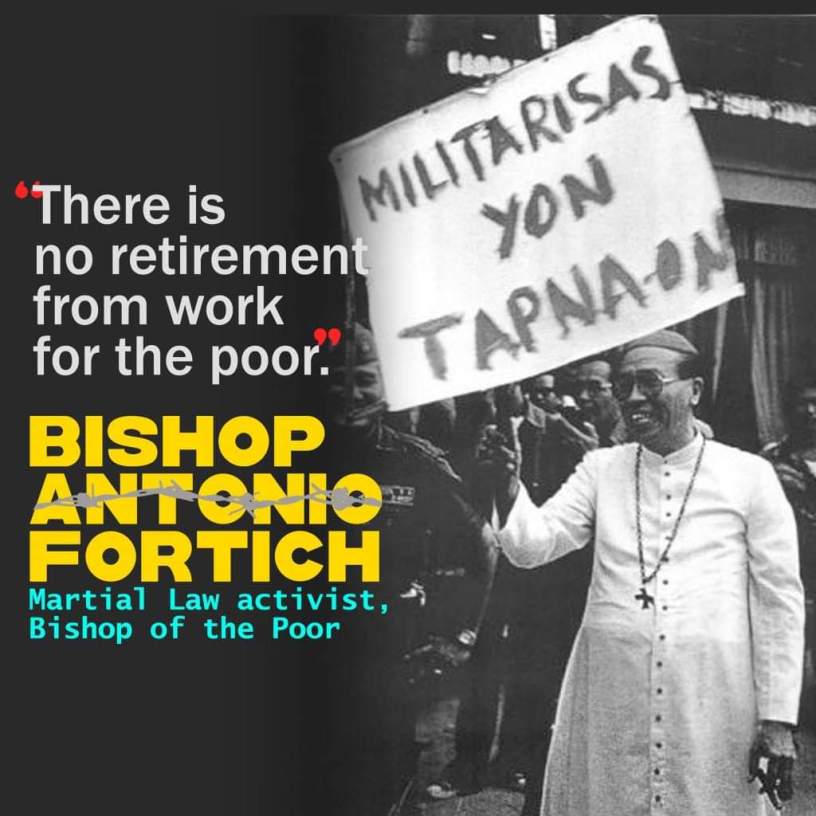
Bishop Antonio Fortich is a martial law figure known for advocating for civil and political rights and the rights of the poor, the sakadas, and the small farmers during the martial law period. His engagement with the poor and the oppressed led to the creation of the Social Action Center and the classification of church property under agrarian reform. He also started a radio station and a television station. In 1969, Bishop Fortich issued a pastoral letter which urged landowners to increase the wages of the sakadas and to allow workers to form unions.
I have no problem with a world in which there are rich and poor; you have an automobile, I have a bicycle, so what? But I cannot accept that some people have to live by scavenging for food in the garbage cans of others
Bishop Fortrich on social equity amongst all people
Fortich’s vocal and blunt criticisms of the situation of Negros Island became the reason for many international media outlets to document the abuses and the sufferings in the island in the 1980s. The drop in international sugar prices, the monopoly of the sugar industry by Marcos cronies and the elites, and the small wages caused massive hunger and poverty during the 1980s under Marcos. Through the picture of Joel Abong, the world discovered the story of Negros under Marcos. He started the Kristiyanong Katilingban or the Basic Christian Communities which used non-violence activism to advocate land reform, human rights, and the fall of Marcos. Bishop Fortich used his influence and power to encourage religious groups, religious workers, and Catholic schools to organize, to stand with the poor, and to criticize the Marcos dictatorship. His activism converted many religious workers into activists.
We are sitting on a social volcano, which could erupt anytime.
Bishop Fortrich on the vitality of the situation in Negros Island.
Due to his involvement in human rights work, with progressive groups, agrarian reform, and in the anti-Marcos struggle, he was often a subject of death threats and violence by right-wing groups. He survived a fire and a bombing. He and other religious workers were labelled as “communists” under the Marcos dictatorship and the C. Aquino administration. Despite the threats and violence, he continued pursuing social justice for the poor.
There is no retirement from work for the poor
Bishop Fortrich
Bishop Fortich criticized the abuses and the oppression experienced by Negrosanons under Marcos and the Negros elites. He became the co-chairperson of the National Ceasefire Committee, which sought to facilitate regional peace talks between the Philippine Government and the New People’s Army. His involvement in social justice inspired 150,000 citizens of Bacolod to welcome National Democratic Front negotiators in Bacolod City during the 1986 ceasfire.
He was born into a landed family in Dumaguete, the Yapsutco-Fortich. Aside from his human rights activism, he is also credited for starting the mass-based rosary warrior Barangay ng Virgen movement. The Bishop also helped create a peace zone in Negros, the Kaisahan Settlement in Candoni, and the Dacongcogon Sugar and Rice Milling Cooperative. We remember you, Bishop Antonio Fortich. We will never forget.

