
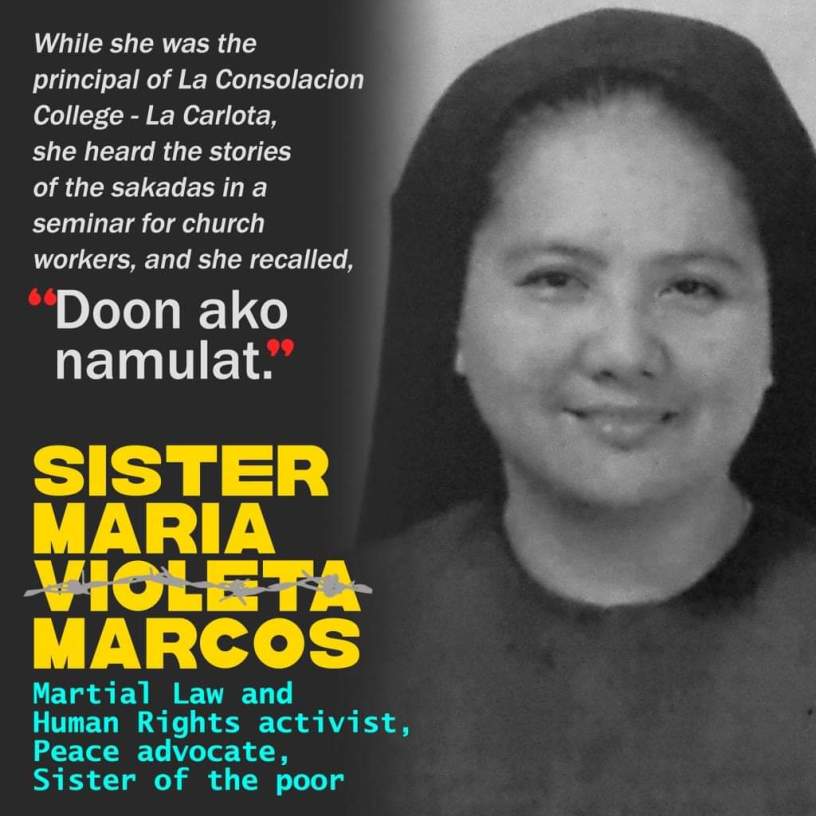
A Martial Law and Human Rights activist, Peace Advocate, and a Sister of the Poor.
In commemoration of the birthday of late dictator Ferdinand Marcos as well as in light of Congress pushing for legislation honoring the deceased tyrant, Negros Remembers has collaborated with Paghimutad in refreshing memories about Martial Law in Negros Island
Sister Maria Violeta Marcos was assigned to be the administrator and the principal of La Consolacion College – Carlota City. She became ‘woke’ when she attended a seminar for church workers wherein she heard the stories of sakadas. Despite the sugar industry being very lucrative and profitable, sakadas were underpaid and abused.
Maria became active in the Social Action Center and was instrumental in persuading Bishop Antonio Fortich to become more vocal. In 1975, Sister Violeta left the school and pursued the path of activism by establishing the Negros Occidental Women Religious Association and by joining the Justice for Sugar Workers Committee. Later, she joined Task Force Detainees under the Catholic organization – Association of Major Religious Superiors of the Philippines.
The murder of civilians for no apparent reason and the police and military harassment of parishes that supported the causes of the poor along with the sakadas were normalized under Marcos’s Martial Law. Sister Violeta documented, lobbied, and campaigned against human rights abuses, torture, and enforced disappearances.
While church workers became more critical of the Marcos administration and of the oppressive amo-sakada system in Negros, Sister Violeta organized the documentation and the protest against the summary execution of other Catholic lay leaders.
Towards the end of the 1970s, Sister Violeta joined protest rallies against militarization, land-grabbing, and oppression of powerless groups. In response, the Marcos administration sent the Long Range Patrol to launch “Walang Patawad” which was a crackdown on dissent and protesters. Summary executions in the public were organized by armed groups and goons.- Sister Violeta’s documentation, lobbying, and protesting persuaded Bishop Antonio Fortich to side with the poor and to become more vocal against the abuses that were happening in Negros and in the Philippines under landlords and Marcos.
In the 1980s, Sister Violeta moves to Manila but continues with her activism with the Task Force Detainees and with reforming the Augustinian Sisters of Our Lady of Consolation (ASOLC) from within.
In July 1989, Sister Violeta, 36 sisters, and three novices left ASOLC to establish the Augustinian Missionaries of the Philippines (AMP).
“…[we] felt its charism of ‘compassion with the poor people’ had been replaced with the creation of schools serving the middle and upper-middle classes…”
Sister Violeta to the United Catholic Asian news in establishing the Augustinian Missionaries of the Philippines
Sister Violeta also reportedly was a consultant for the peace talks between the CPP-NPA-NDF and the Philippine Government.

