

Report by Andres Mapa
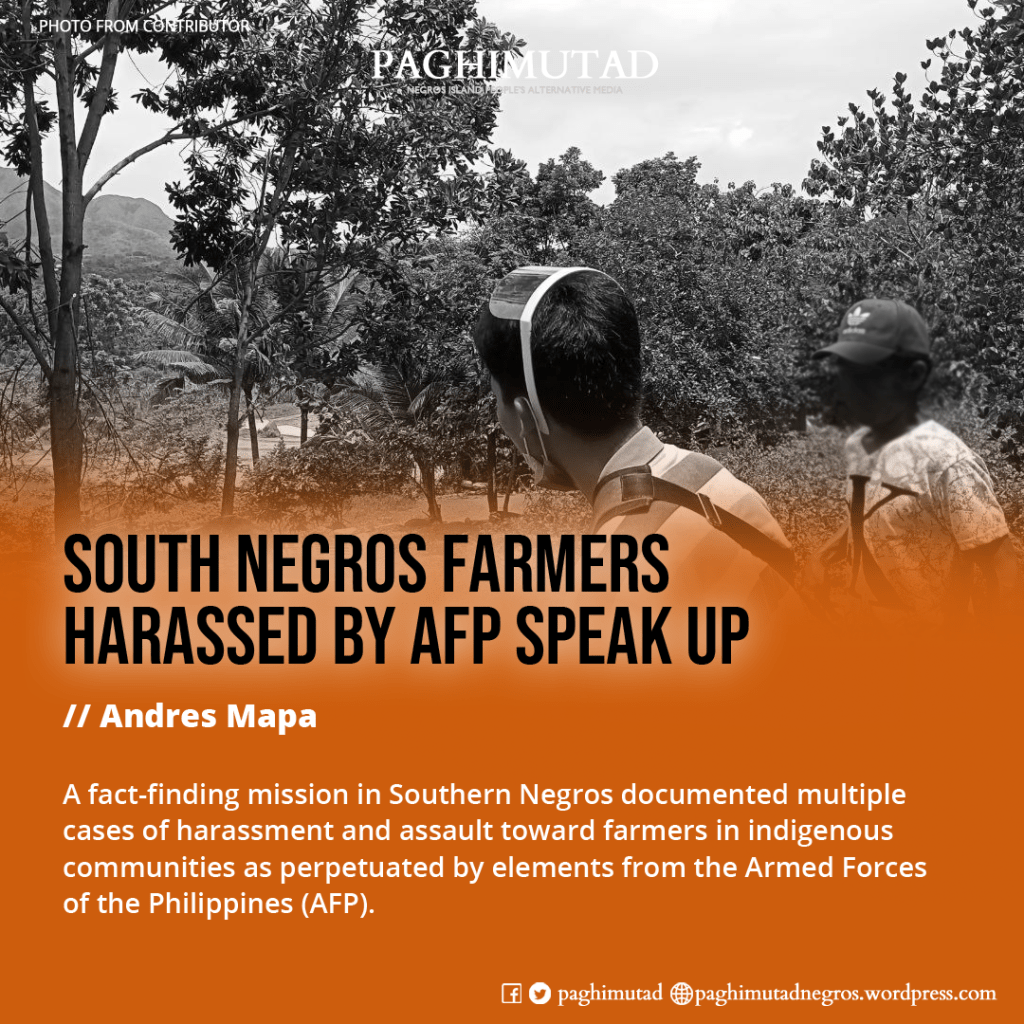
A fact-finding mission in Southern Negros documented multiple cases of harassment and assault toward farmers in indigenous communities as perpetuated by elements from the Armed Forces of the Philippines (AFP).
Led by the September 21 Movement South Negros, along with church workers, volunteer health workers, and representatives from the Himamayan LGU, the outreach program and fact-finding mission was held on July 4 at Sitio Lonoy, Brgy. Carabalan, Himamaylan City, a highly-militarized area in South Negros.
“Back in [South Negros], we can’t tend to our farms well because the military keeps on interrogating us and encircling us like dogs. We live in fear all the time,” Josephine Piduhan, a representative from September 21 Movement South Negros, said at a press conference earlier today, where the group presented their findings, along with the first-hand narratives of the victims themselves.
“We call on the military to stop the killings in the countryside, as well as here in the cities. They call farmers as NPA in order to target them, when in truth us farmers are simply doing our jobs of planting the food that people consume,” she added.
Kicked and threatened
Residing in Sitio Lonoy, Bonifacio Gonzales, 52, a farmer of the Ituman Magahat Bukidnon Tribe told the fact-finding team that he was kicked repeatedly by elements from the 94th and 62nd IB in the noon of June 9 after being questioned for the whereabouts of alleged New People’s Army ( NPA) fighters in the vicinity.
According to Gonzales, the battalion already arrived a day prior, June 8, but remained in a densely forested area, where they camped.
Earlier in the morning of the next day, June 9, Gonzales claimed elements from the military went in front of his house to ask for water. Seeing that there wasn’t enough water for all of them, the military men told Gonzales to fetch water at a stream nearby for them.
Gonzales said the military had not mistreated them that morning. The men even cooked rice in his front yard.
About five minutes later, they heard a series of gunshots. Gonzales estimates it had been one kilometer away from where they were.
At two in the afternoon, the military men went back to his house and captured him and forcibly brought him to the house of Erming Kisan, the victim of the shooting incident earlier that morning, which was the source of the gunshots they have heard.
Gonzales was interrogated by the armed forces as to the whereabouts of the NPA fighters in the area. He told the military elements that he had no idea where they were.
“It’d be better if you just die,” the man wearing army fatigues said.
Gonzales replied, “Even if you killed me, I still can’t do anything.”
That was when one of the armed men kicked Gonzales repeatedly and called him a liar. Further, the military elements threatened to tie him up and kill him in the forest.
“But they didn’t do anything. In that moment I was no longer afraid to die,” Gonzales told the fact-finding team.
The military surveyed the nearby areas and eventually released Gonzales from capture.
Before he got to leave, an estimated 30 additional troops arrived. Gonzales heard one of them saying, “Why didn’t you just kill the man left in that house?”
It was already past five in the afternoon as Gonzales escaped into the densely forested area.
As it was already too dark by then, he stayed put in that area despite the heavy downpour. According to Gonzales, he couldn’t just continue walking for fear that he would encounter the military elements.
Hungry and cold, Gonzales told the fact-finding team he remembers feeling angry and scared.
“It is clear that we are civilians and yet they vent their anger on us. Even in my old age, they still physically assaulted and hurt me,” Gonzales said.
“They should stop bullying us civilians. And if they encounter the armed rebels themselves, the military doesn’t even put up a good fight. The encounter did not even inflict a single scratch on [the NPA fighters],” he added.
At present, Gonzales’ residence and plot of land are unattended due to the fear of military elements coming back for him. All his produce and farm animals have been left alone, too.
He is currently taking refuge at a different house. Gonzales lives alone as the rest of his family live in Binalbagan.
He calls on city officials to make a swift investigation on the matter and to protect farmers like him who live in militarized areas.
“If my safety is assured, I would choose to go back to my farm. My livelihood has always been there,” Gonzales said.
Families harassed and displaced
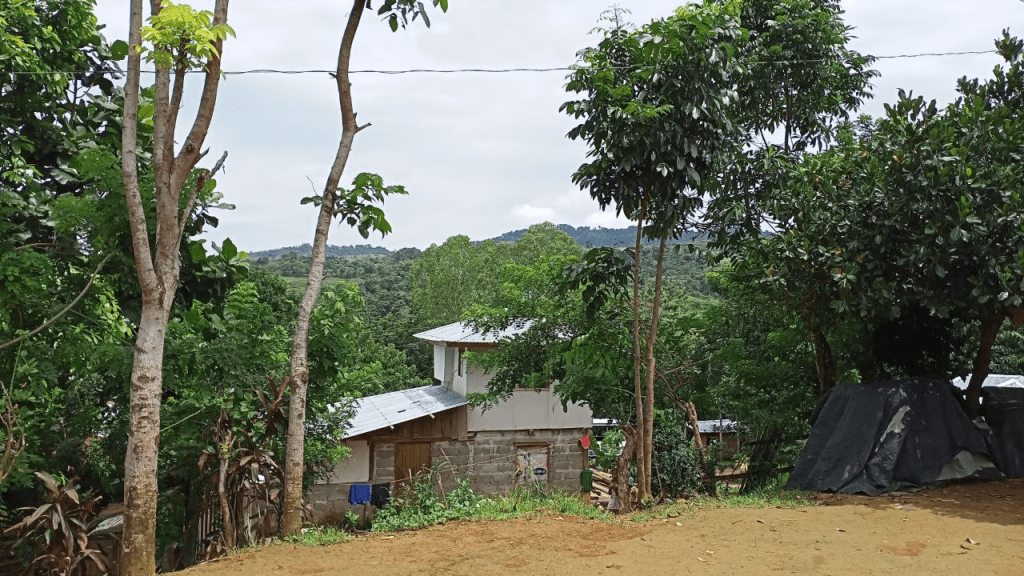
In nearby municipality Binalbagan, at Sitio Malalag Uno, Brgy. Biao, elements from the 62nd Infantry Battalion physically assaulted the Lopicio family and ransacked their house last June 9.
A day prior, June 8, farmer Raymundo Lopicio, 55, of the Ituman Magahat Bukidnon tribe recounts the soldiers asking them where the NPA camp was. About fifty elements from the battalion, all without name tags, conducted a military operation on the area.
The following day at 11 a.m., he heard gunshots and saw the soldiers running toward their house, compelling them to come down.
The family complied and went down with a gun pointed at their heads. One of the soldiers stepped forward to kick Raymundo.
The three of them— Raymundo Lopicio, Reneju (eldest son of Ailyn and Raymundo), and alias “Ukling” Sabio (nephew of Raymundo) — were dragged to an isolated place, 100 meters from their house. Their hands were tied by a rope behind their backs.
Raymundo was interrogated and since he had nothing to say, he was called a liar and other degrading words while one of the soldiers beat him, hitting the right side of his abdomen.
Afterwards, the soldiers told them they had to move because the troops would fire a mortar near the area.
Thus, they arrived at their neighbor Antie Laling’s house, and the three of them were tied up on a tree in order to be interrogated. Soldiers punched Ukling Sabio while he was tied up.
At around 2 p.m., they heard the three shots from the mortar. By then, all three of them were gripped with fear.
They were released past 3 p.m. without any food in their stomachs.
Meanwhile, Ailyun Lopacio, wife of Raymundo, remembers preparing breakfast at 6 a.m. of June 9 when they first heard multiple gun shots.
“You said there were no NPAs here, why did our troops have an encounter?” The soldier shouted at Ailyn.
Immediately, they packed their belongings and left 100 meters away from their house.
As his husband, eldest child, and husband’s nephew were captured for interrogation by some soldiers, Ailyn and their two daughters, Rodelyn (13 years old) and Rosemarie (10 years old) remained at their house and witnessed how the military elements scattered and damaged their belongings as if looking for something.
The youngest Rosemarie was trembling and crying as she saw their inverter and solar panel being broken by a soldier.
After an hour, Ailyn and the two daughters were also brought to the nearby house where the three other men were tied in a tree.
They were also released at 3 p.m., along with the three tortured men.
In Sitio Malalag Uno, 21 households have already been displaced, including the Lopicio family, due to constant fear from military attacks and threats.
Address the roots of armed struggle – progressive groups
“If they continue harassing civilians, you can no longer blame them if they choose to hold arms and join the NPA. [The military] is the one pushing these people to be NPA,” Raymundo said during the press conference.
“What we want is peace, not killings and war,” he added. “We are asking for security for our homes and livelihood.”
Raymundo explains that he is not literate and “can’t read words as big as the carabao.”
He adds that the countryside is where they thrive as a community and farming is what they know best. He calls on the government to secure their homes and livelihood there.
Danilo Tabura of Kilusang Mambubukid ng Pilipinas (KMP) Negros said they will be studying the data from the fact-finding mission in order for them to file a case against the perpetrators from the military.
Meanwhile, Ereneo Longinos of Bagong Alyansang Makabayan (BAYAN) Negros says that the reality of the civil war between the Philippine government and the CPP-NPA-NDF requires us to look at the roots causes of this armed conflict.
“The Geneva Convention is supposed to ensure the safety of civilians amid this civil war. The state forces should answer to this violation,” he says.
Longinos calls on the national government to continue peace talks as it will address the centuries-old problem of landlessness through genuine land reform, as well as the continuing poverty and unemployment of our people through national industrialization.
“The armed conflict will persist if these fundamental problems are not addressed”, Longinos said.
###

