
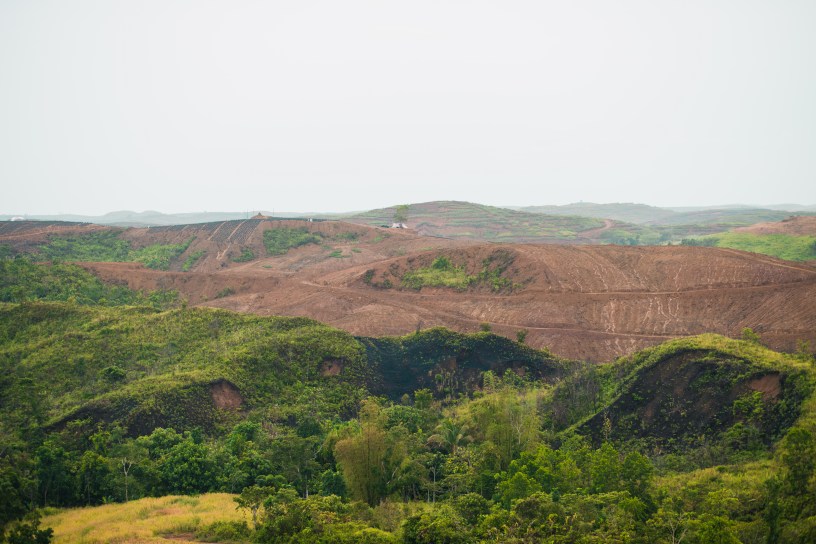
Hacienda Asia Plantations, Inc. (HAPI) has temporarily suspended its earth-moving operations in Candoni, Negros Occidental following a June 11, 2025 multisectoral dialogue with the Department of Environment and Natural Resources (DENR), the Provincial Environment Management Office (PEMO), church leaders, and civil society organizations.
The suspension comes in the wake of mounting public pressure and formal findings of multiple environmental and regulatory violations. Farmers and Indigenous Peoples (IPs) on the ground, however, say the pause is not enough, and are demanding HAPI’s total pull-out from their lands.
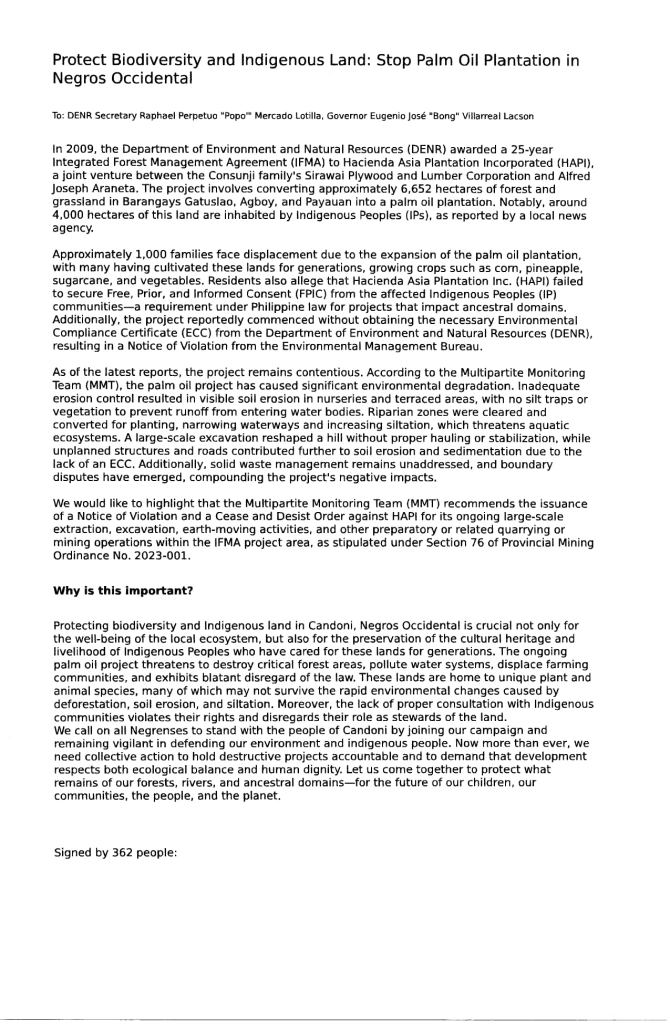
In a public statement, Candoni farmer and Indigenous group SAVE TABLAS acknowledged the development but stressed that it is only a partial response to community demands. “Ini nga temporaryo nga pagpahunong bunga sang pressure halin sa pumuluyo. Pero indi ta mangin kampante diri,” the group said.
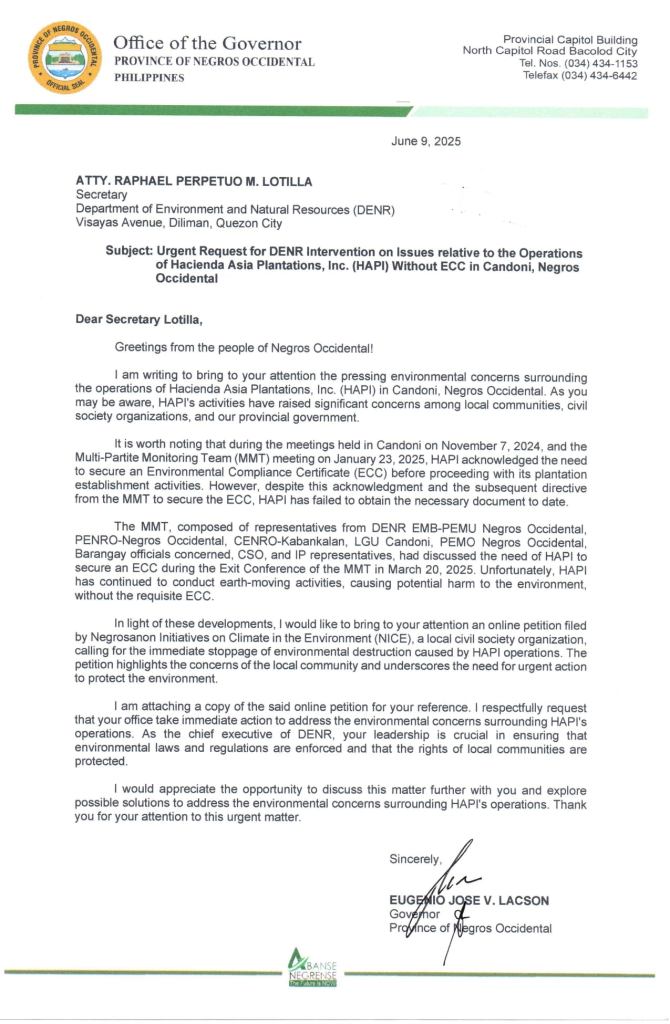
Earlier, Negros Occidental Governor Eugenio Jose “Bong” Lacson wrote to DENR Secretary Raphael Lotilla, flagging HAPI’s continued operations despite lacking an Environmental Compliance Certificate (ECC). He urged the DENR to take “immediate action to address the environmental concerns surrounding HAPI’s operations.”
He said that during meetings in November 2024 and January 2025, HAPI had “acknowledged the need to secure an ECC” and was formally directed by the Multipartite Monitoring Team (MMT) to do so.
Despite this, Lacson noted that HAPI has failed to comply with ECC requirements, prompting him to escalate the issue to the DENR.
The Governor’s letter also referenced a growing community petition initiated by civil society group Negrosanon Initiatives on Climate and the Environment (NICE), which had gathered over 360 signatures.
In the petition, NICE described HAPI’s activities as “a large-scale conversion of forests and grasslands” that threatens to displace “approximately 1,000 families,” many of whom belong to Indigenous communities.
It alleged that “approximately 1,000 families face displacement” and that “HAPI failed to secure Free, Prior, and Informed Consent (FPIC)” from Indigenous Peoples, as required by law.
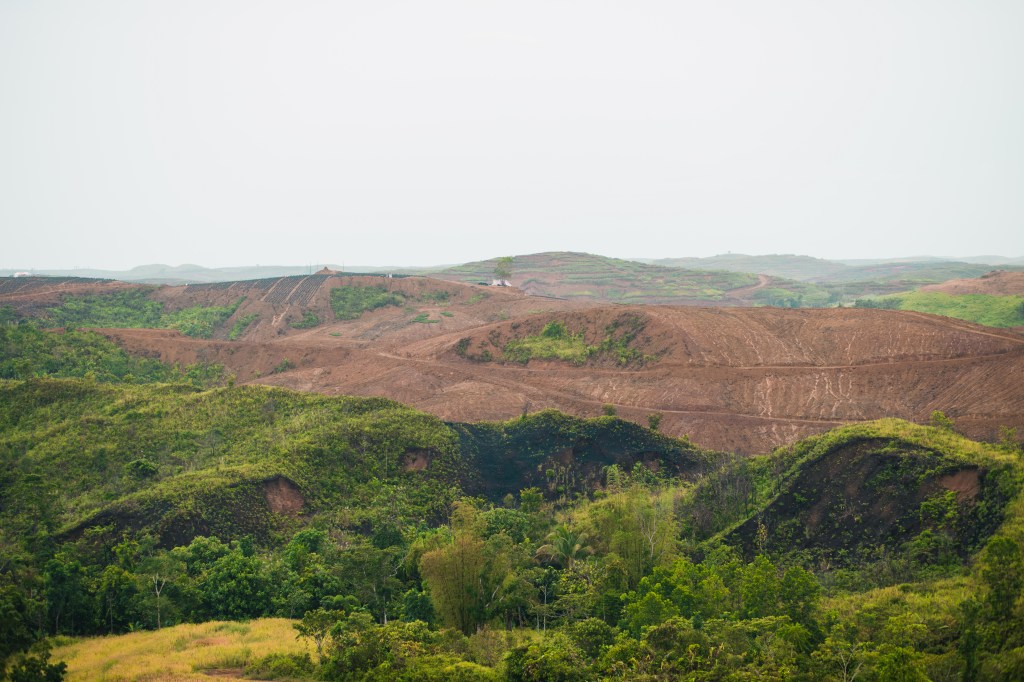
Citing findings from the MMT, NICE stated that “inadequate erosion control resulted in visible soil erosion,” while “riparian zones were cleared,” and “siltation threatened aquatic ecosystems.”
According to the petition, the MMT recommended the issuance of a “Notice of Violation and a Cease and Desist Order” against HAPI for its large-scale activities and environmental degradation.
In response to Lacson’s letter, SAVE TABLAS issued a public statement welcoming the move but stressing that “compliance with ECC is not enough.”
“Bisan pa ‘legal’ ang palm oil plantation kag kompleto ang papeles, peligro gihapon ini sa amon duta, katubigan, seguridad sa pagkaon, kag kabuhi,” SAVE TABLAS said in its statement.
(Even if the palm oil plantation is considered “legal” and has complete documentation, it still poses a threat to our land, water, food security, and our lives.)
The group added: “Wala sang papeles nga makabayad sang kasakit kag kadaut nga dala sini sa kagubatan, kasubuan, kag sa katawhan.”
(No legal paperwork can pay for the misery and destruction it has caused to the forests, rivers, and our people.)
SAVE TABLAS called for the “revocation of HAPI’s IFMA and the full pull-out of its operations in Candoni,”, end to the militarization of the area, the “return of land to Indigenous Peoples and local farmers,” and “reparations for displaced residents and destroyed ecosystems.”
They also demanded a “moratorium on all new palm oil projects in Western Visayas and the Philippines” and accountability for “DENR officials and political allies who enabled HAPI.”
The group also challenged HAPI’s claims of economic benefit, saying, “Bisan ang ginpromisa nga trabaho sa komunidad, nagtuga lang sa mga mamumugon nga nubo ang sweldo, wala sang benepisyo, kag makatalagam nga kondisyon sa trabaho.”
(Even the promised jobs in the community have only resulted in workers receiving low wages, no benefits, and facing hazardous working conditions.)
“Indi lang simple nga pagsunod sa legalidad ang sabat sa amon nga mga demanda. Ang amon hingyo: hustisya,” the group said.
(Simply complying with HAPI Inc.’s legal documents is not the answer to our demands. What we seek is justice.)
As of this writing, the DENR has not publicly responded to Lacson’s letter or the petitions.
 Paghimutad