
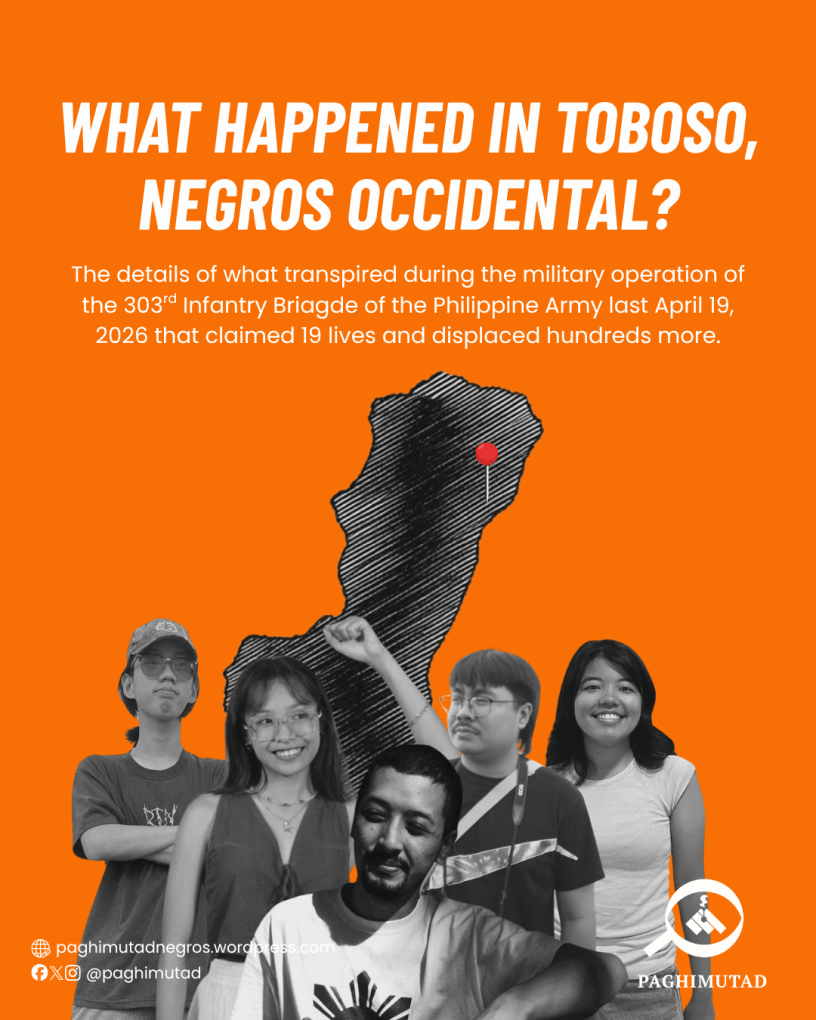
BACOLOD CITY, Negros Occidental — Nineteen people were killed by a military operation in Toboso, Negros Occidental last April 19. Among those killed were journalists, student leaders, researchers and community workers, while the Philippine military maintains all those killed were New People’s Army rebels.
The Armed Forces of the Philippines said troops from the 79th Infantry Battalion, under the 303rd Infantry Brigade of the 3rd Infantry Division, clashed with supposed NPA members at about 3:58 a.m. on April 19 in Barangay Salamanca. The military said the operation was launched after verified reports from residents about the presence of armed rebels in the area.
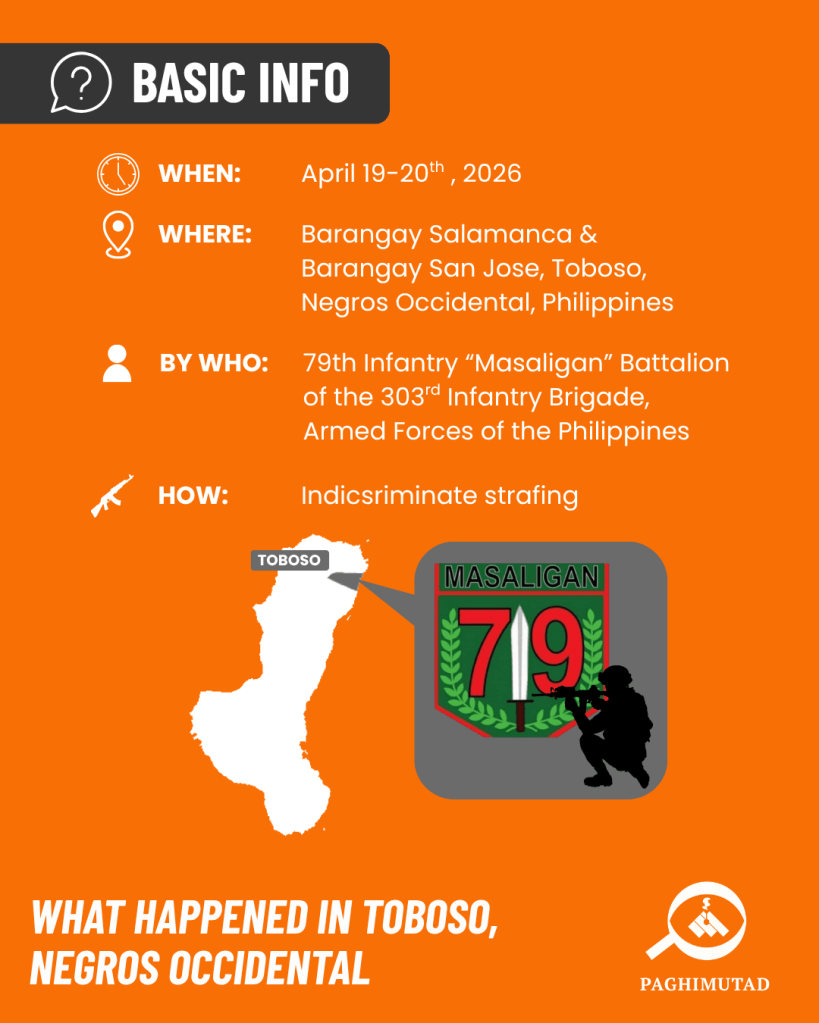
The AFP said the encounter developed into running firefights throughout the day, resulting in the deaths of 19 people and the alleged recovery of 24 firearms. It said the troops followed rules of engagement and observed civilian safety.
But human rights and media groups disputed the military’s account, saying the operation included indiscriminate strafing for more than 12 hours. Karapatan said the intensified military operations were followed by the forced evacuation of 653 residents from 168 households on April 20.
Furthermore, an additional 200 residents living between Escalante City and Toboso were also forced to flee.
The initial clash site was reported to be in Sitio Sinugmawan. Rights groups said this point is crucial because some of those killed were reportedly not at the initial clash site.
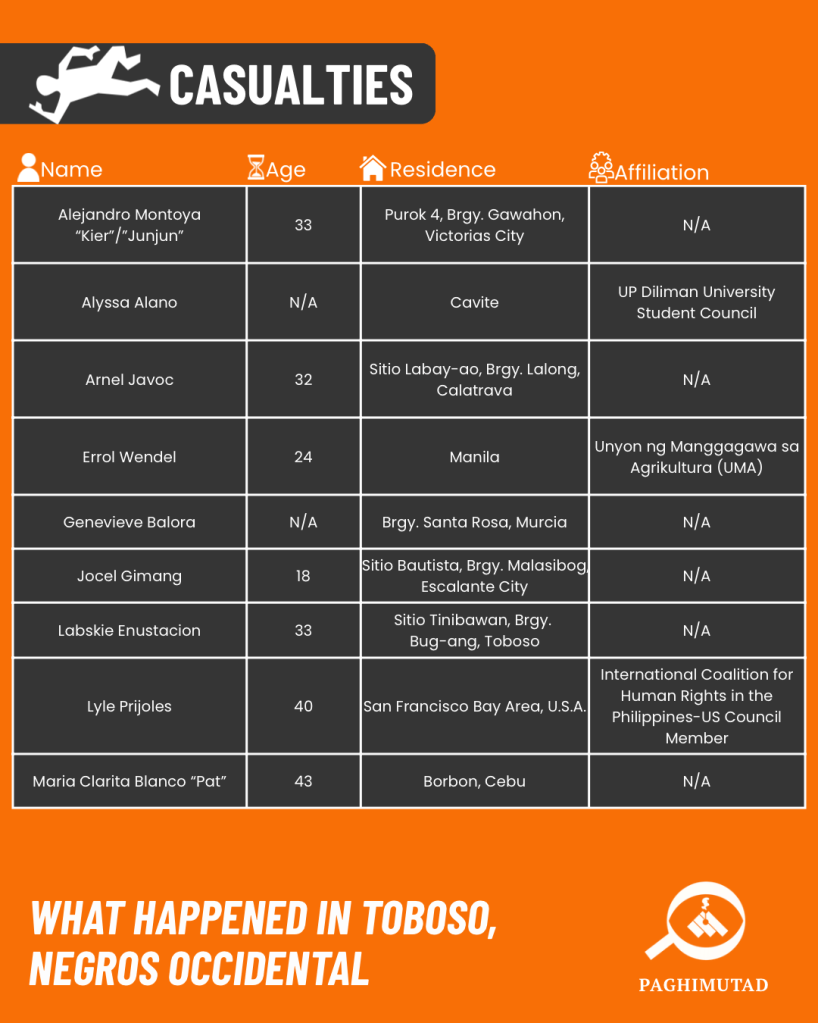
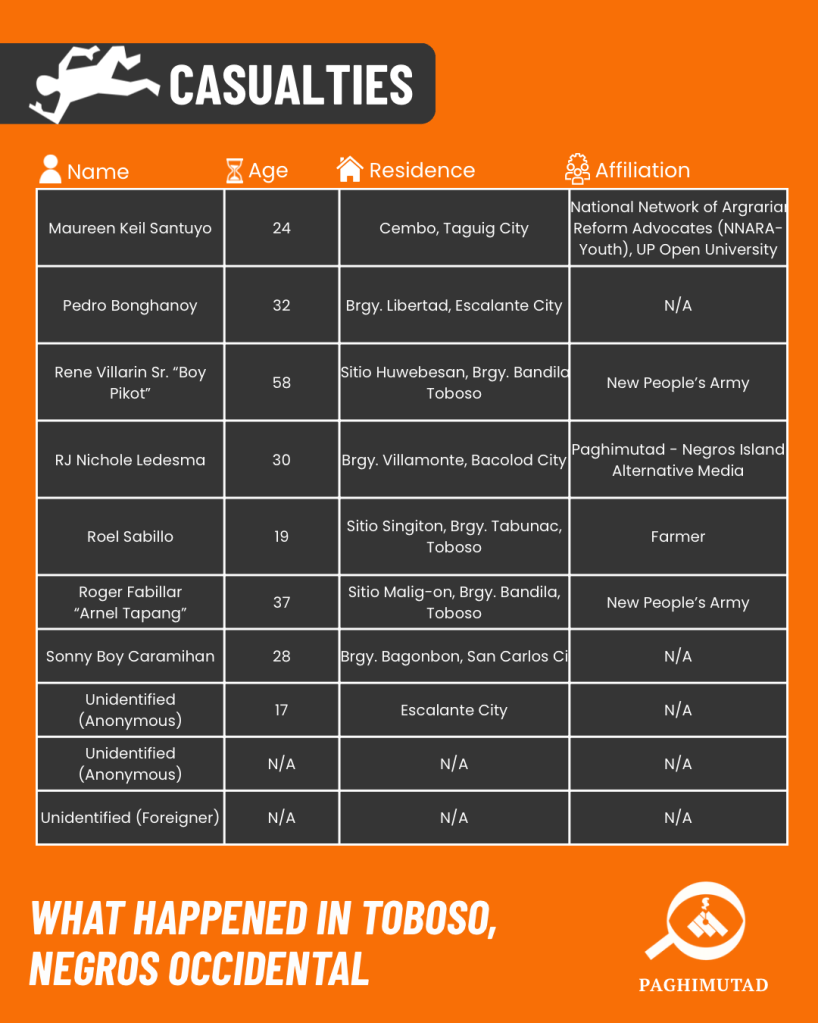
Among the dead was RJ Nichole Ledesma, a writer and editor of Paghimutad-Negros and regional coordinator of Altermidya in Negros Island. The Human Rights Alliance Negros, through Altermidya, said Ledesma was in Sitio Plariding reporting on the effects of renewable energy projects, including a solar farm expansion and windmill projects affecting farmer communities, when he was reportedly attacked.
Altermidya said Ledesma was doing community work and immersion reporting, not taking part in combat.
Also among those identified were Alyssa Alano, an Education and Research councilor of the University of the Philippines Diliman University Student Council; Maureen Keil Santuyo; Errol Wendel; Roel Sabillo; and Lyle Prijoles, a Filipino-American human rights advocate from California.
The Unyon ng mga Manggagawa sa Agrikultura (UMA) added that the researchers and advocates slain were documenting conditions in agrarian communities.
Karapatan also alleged a 24-hour media blackout following the operation, saying the delay in public reporting prevented immediate scrutiny of the deaths and displacement.
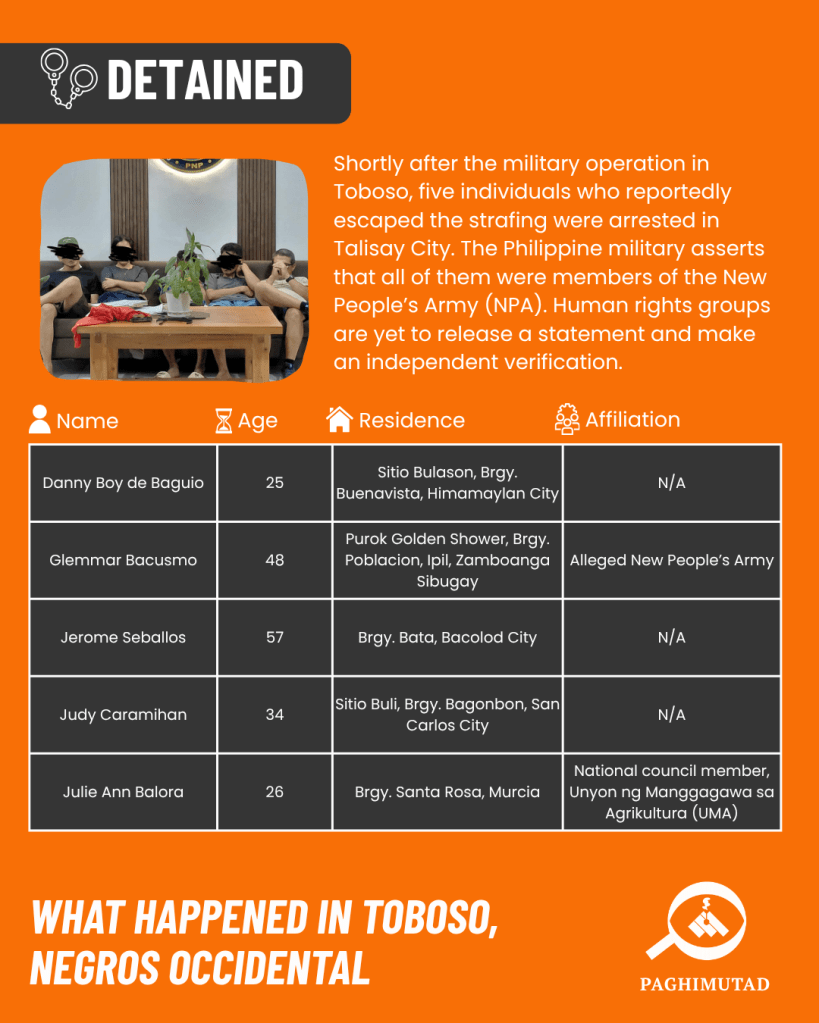
Aside from the fatalities, five individuals who reportedly escaped the military operation were arrested in Talisay City, Negros Occidental, accused by the Philippine military of also being members of the New People’s Army.
Human rights groups have yet to issue a statement on the arrested individuals. One of them has been identified as Julie Ann Balora, a member of the national council of Unyon ng mga Manggagawa sa Agrikultura and National Federation of Sugar Workers.
The NPA’s Apolinario Gatmaitan Command also disputed the military’s claim that all 19 fatalities were guerrillas, saying only a small squad led by Roger Fabillar, also known as Arnel Tapang, was involved in the clash. The military confirmed that Fabillar, whom it described as a ranking rebel leader, was among those killed.
Police later formed the Special Investigation Task Group “Toboso” to identify the bodies through forensic examination and coordination with local governments and families.
Rights groups called on the Commission on Human Rights to investigate possible violations of human rights and international humanitarian law, as well as for the 303rd Infantry Brigade to be held accountable for what they call a “disregard of international humanitarian law”
The AFP has denied wrongdoing and said the operation was a legitimate encounter with armed rebels.
In the aftermath of the incident, dozens of organizations across multiple sectors nationwide have released statements of condemnation and calls for accountability.

