
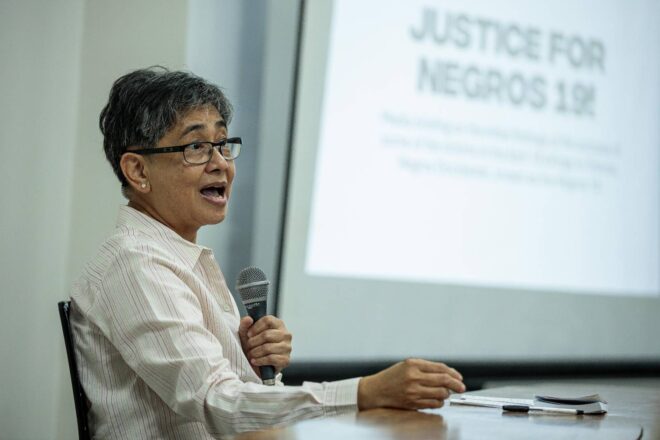
BACOLOD CITY, Philippines — A human rights group from Negros Island said preliminary autopsy findings by forensic pathologist Dr. Raquel Fortun support allegations that the April 19 military operation in Toboso, Negros Occidental, may have involved grave violations of international humanitarian law.
Human Rights Advocates Negros (HRAN) said Fortun’s initial findings “verified” its view that the deaths of 19 people in the operation amounted to a massacre. The group said the findings strengthened its call for accountability from the Army’s 79th Infantry Battalion and the 303rd Infantry Brigade.
The April 19 operation left 19 people dead in what the Armed Forces of the Philippines has described as a legitimate encounter between soldiers and New People’s Army guerrillas. Human rights groups, relatives, and activists have questioned the military’s account and called for an independent investigation.
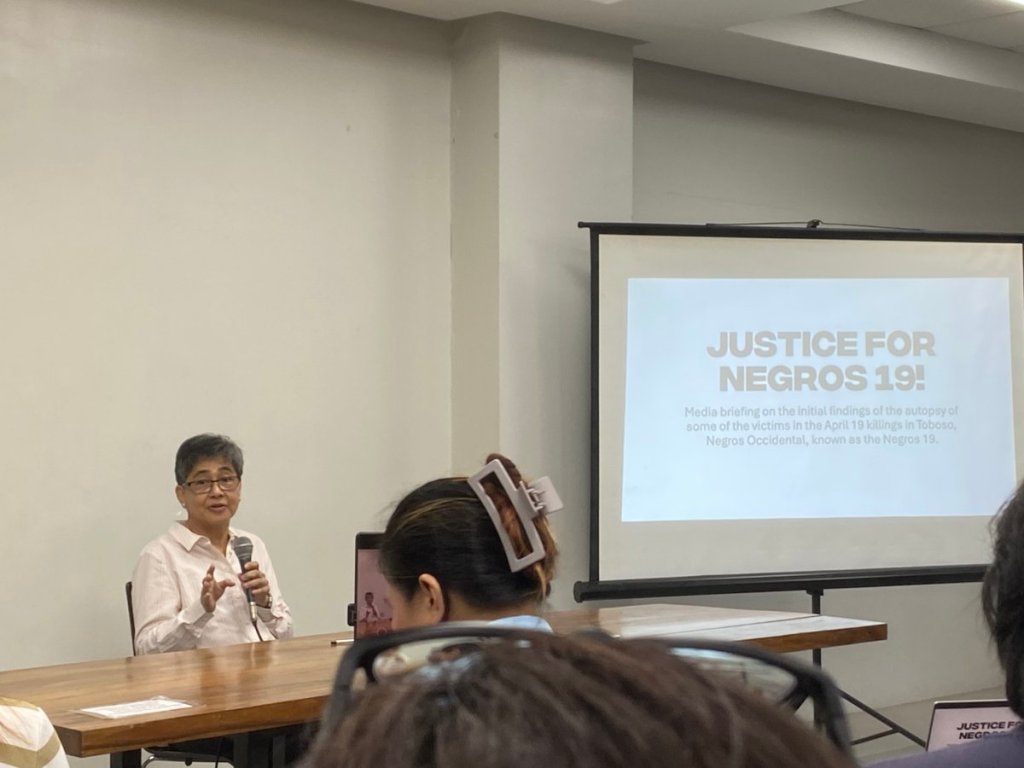
Fortun presented initial findings Thursday, May 7, at the University of the Philippines Diliman after conducting autopsies on five of the 19 bodies, Altermidya reported. She said the bodies were already in an advanced state of decomposition and raised concerns over the handling of remains, the apparent lack of a credible crime scene investigation, the removal and discarding of clothing, and the reported misidentification of at least one body.
Among the most serious concerns, Fortun said some victims sustained gunshot wounds to the back. She also said one body had a leg wound that punctured veins, raising questions about whether the person could have survived had medical assistance been provided. Refusing aid to a wounded person who is hors de combat is generally considered a war crime under international humanitarian law, Fortun said.
HRAN said the absence of gunpowder burns on the bodies contradicted the military’s claim that the dead had used firearms. The group also said the victims were shot from behind and denounced what it called the “brutal and barbaric neglect” of the cadavers after they were recovered.
“It clearly shows that adherence to IHL by the Philippine Army is empty talk and lip service,” HRAN said, adding that its documentation since 2022 has recorded massacres, killings of civilians and persons hors de combat, abductions, and continuing impunity in Negros.
Fortun also criticized the use of paraffin testing, which she said is obsolete and inconclusive. She said proper gunshot residue testing requires protecting the hands, which she said was not done in at least one case involving a body found in water. She urged other families to allow independent autopsies and called on the Commission on Human Rights to help recover and identify the remaining remains.
Meanwhile, the National Task Force to End Local Communist Armed Conflict urged the public to wait for the full official report, saying Fortun’s preliminary observations should be treated “with respect, but also with sobriety, context, and patience.”
NTF-ELCAC Executive Director Ernesto Torres Jr. said findings on five bodies do not establish a massacre and should be assessed alongside crime-scene processing, ballistic examination, chain-of-custody review, witness accounts, operational records, and medico-legal correlation.
Torres said the alleged mishandling of evidence should be viewed in the context of a hazardous combat recovery operation, where troops and police “faced the possibility of improvised explosive devices, booby traps, and armed stragglers.” He said the military maintains the Toboso deaths resulted from running firefights throughout the day, with 24 firearms recovered.
“Deaths in armed conflict are always unfortunate. But unfortunate does not automatically mean unlawful,” Torres said, adding that persons directly participating in hostilities may be lawful targets unless they are captured, surrendering, or otherwise hors de combat.
HRAN rejected the government’s framing and urged Negros residents to demand accountability, saying impunity and the lack of effective accountability mechanisms have made justice “unattainable.”

