
by Andrea Mae Ecoy
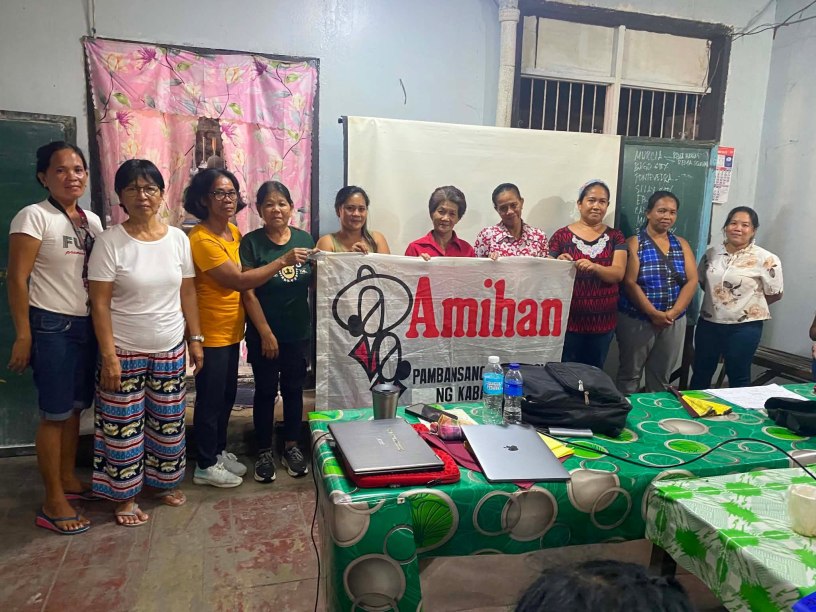
BACOLOD CITY — More than 70 peasant women from eight municipalities across Negros Occidental gathered in Bacolod City on August 16 for an orientation on Amihan, marking an initial step toward reorganizing the peasant women’s formation in the province. The activity introduced the organization’s role and the struggles of peasant women, while participants also formed a preparatory committee tasked with laying the groundwork for Amihan Negros.
The gathering was facilitated by Cathy Estavillo, secretary-general of the Amihan National Federation of Peasant Women and spokesperson of Bantay Bigas. It tackled the national situation of landlessness, land use conversion, the neoliberal economy confronting peasants and peasant women, as well as corruption and bureaucrat capitalism.
“Tinalakay sa pagpupulong ang pambansang sitwasyon ng kawalang-lupa (landlessness), pagpapalit-gamit ng lupa (land use conversion), neoliberal na ekonomiyang kinakaharap ng mga magsasaka at kababaihang magbubukid, at korupsiyon at burukrata-kapitalismong naglilingkod sa interes ng mga dayuhang korporasyon at iilang negosyante sa bansa,” said the Kilusang Magbubukid ng Pilipinas (KMP) Negros, underscoring the interconnected issues confronting peasants and peasant women at both the national and local levels.
The discussion then turned to how these broader issues manifest in Negros, where peasants and peasant women continue to confront longstanding inequalities in the agricultural sector. The participants linked these conditions to the province’s history of land concentration and the continuing struggle of peasant communities to defend their livelihoods.
“Tuon sa Negros, tinalakay ang ilang siglo nang pag-iral ng sistemang hacienda kung saan hindi sapat ang sahod ng mga manggagawa; ang pagsira sa mga lupang agrikultural para palitan ng solar farms, palm oil plantations, at poultry farms; ang programang SPLIT (Support to Parcelization of Lands for Individual Titling) ng gobyerno at World Bank na naglalayong hati-hatiin ang kolektibong lupa ng mga magsasaka; at ang patuloy na paglaban ng mga magsasaka at kababaihang magbubukid sa mga ito,” said KMP-Negros, highlighting the specific conditions and continuing struggles of peasants and peasant women in the province.
The issues raised in the orientation also connected local agricultural struggles to broader national economic policies. KMP-Negros linked the conditions faced by Filipino peasants to the continued implementation of neoliberal policies, agricultural importation, and the weakening of local food production.
“The neoliberal policies, which the Marcos Jr. continually adheres to further push the peasants to abject poverty and hunger, unabated importations of agri products that weakens the local food production and facilitates landgrabbing. The Filipino peasants suffer greatly from the government blind adherence to globalization and neoliberalism,” said KMP-Negros, blaming the Marcos Jr. administration’s continued adherence to neoliberal policies for worsening poverty and hunger among Filipino peasants.
Kilusang Magbubukid ng Pilipinas (KMP) Negros welcomed the formation of the preparatory committee, emphasizing the importance of strengthening the organization of peasant women amid continuing struggles over land and livelihood in the province.
The initiative also drew support from the National Federation of Sugar Workers and Pamalakaya Negros, which expressed solidarity with the peasant women as they begin organizing toward the formation of Amihan Negros.
The orientation was held on the eve of the anniversary of the killing of activist Zara Alvarez and days before the fourth-month commemoration of the Toboso massacre, placing the initial organizing of peasant women within a continuing climate of struggle and repression in Negros.
KMP-Negros called on peasant women and the broader public to unite and fight back against landlessness, land conversion, and policies that threaten peasant livelihoods. As Amihan Negros takes its first steps toward reorganization, the group urged peasant women to strengthen their collective struggle, defend agricultural lands, and stand together against those who profit from the dispossession of the people

