
by Andrea Mae Ecoy
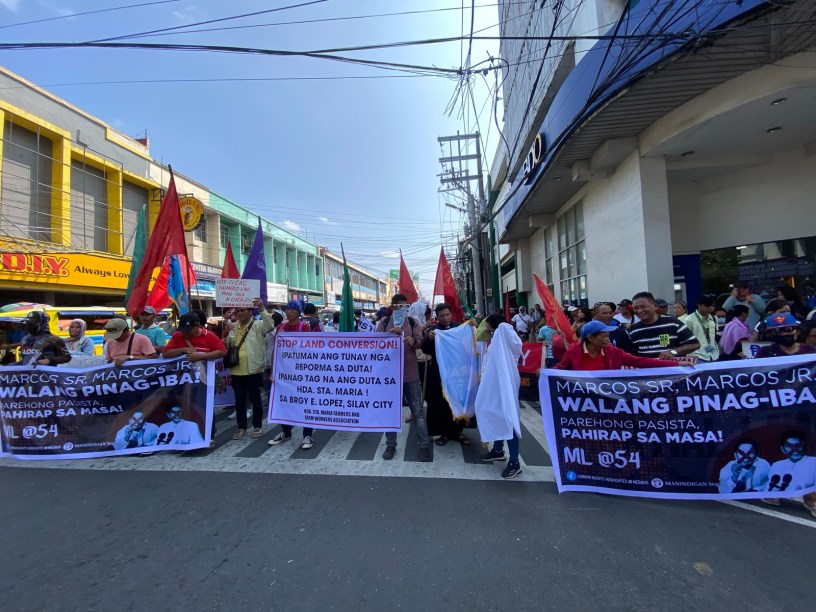
BACOLOD CITY — Different sectors in Bacolod City marked the 54th anniversary of the declaration of Martial Law on Monday by bringing to the streets a call to end what they described as the continuing use of state repression, violence, and restrictions on democratic rights from the dictatorship of Ferdinand Marcos Sr. to the administration of his son, Ferdinand Marcos Jr.
Workers, youth, peasants, human rights advocates, and other sectors joined the mobilization organized by Human Rights Advocates Negros (HRAN) and Manindigan Negros. Beyond commemorating the abuses committed during Martial Law, protesters linked the history of state violence to present-day concerns over corruption, human rights violations, landlessness, attacks on activists, and restrictions on the right to protest.
For the groups, the anniversary is not only about remembering the past but examining what they see as the persistence of repressive state practices under the current administration.
“Sa subong nga adlaw, ika-54 nga paghimakas, wala pagbag-o sa panahon sang Marcos’ dictatorship sang Martial Law. Subong para sa amon, is aini ka de facto Martial Law ang ini ika-54 tungod mas naglala ang human rights abuses, naglala ang kapigaduhon, kag naglala ang massive corruption kung sa diin wala may nakasabat nga mastermind. Although may napriso, subong nakagwa manlang gani,” said Noli Rosales of BAYAN-Negros.
The protesters also tied the question of state repression to corruption, particularly the controversy surrounding flood-control projects. They demanded accountability for the use of billions in public funds, arguing that corruption diverts resources away from services that communities need.
“Ang gusto naton, ang mastermind ang manabat diri. Si BBM mismo ang mastermind sang flood-control project kay nakita naton ang pagpasa sang budget nagaagi ini sa pagpirma ni BBM, pero gin pagustohan lang niya nga mga alipores nga mangulimbat sa kaban ng bayan kung sa diin indi sang million, kundi billion ang corruption,” Rosales added.
The controversy over flood-control funds has direct consequences for communities that continue to face flooding, damaged homes, disrupted livelihoods, and unsafe living conditions. For protesters, the billions allocated for flood-control projects should have gone toward protecting people from disasters and addressing their basic needs, making accountability over the funds a concern not only of government spending but of people’s lives and welfare.
For Kabataan Party-list Negros Secretary General Ann Villasenor, corruption and state violence are closely connected when public funds are used for institutions and programs that, according to the group, contribute to the repression of communities and activists.
“Sa piyak nga bahin sang korapsyon, kabalo kita nga pwede ini maging isa ka delubyo—makamamatay kag nagapamatay paagi sang State Terror nga bilyones ang pondo imbes sa serbisyo para sa tawo—pareho sang NTF ELCAC nga numero uno sa pagpang-redtag. Ukon matawag naton nga bayolente nga gawi sang estado para pahipuson paagi sa intimidasyon, dulaon, ukon pamatyon—konreto ini sa mga mamumugon, mangunguma, lider-estudyante, organisador, aktibista, kag madamo pa nga gahimakas para sa kahilwayan sang kadam-an,” Villasenor said.
She linked the discussion to Negros’ long history of state violence, from the Escalante Massacre to cases that remain etched in the collective memory of communities. Decades later, she said, state resources continue to be used not only for public services but also for counterinsurgency programs such as the National Task Force to End Local Communist Armed Conflict (NTF-ELCAC), which activists have long criticized for red-tagging and intimidation. For communities, she said, the diversion of public funds toward such programs comes at the expense of people’s needs while creating fear among workers, peasants, students, organizers, and activists who speak out and organize for their rights.
“Kagapon lang, aton man ging dumdom ang madugo kag puno sang paghimakas nga ika-kwarentay-uno nga tuig ang nag agi sadto sang Escalante Massacre nga 20 ka mga indibidwal ang ila ging pamatay nga naga-edad lamang 16 kag indi mag lapaw sa 30 ang edad sang mga biktima,” Villasenor said.
The Escalante Massacre took place on September 20, 1985, when 20 demonstrators were killed and 24 others were wounded during a protest in Escalante, Negros Occidental. A 1996 Supreme Court decision documented that the victims were shot by military and paramilitary forces during the Welga ng Bayan.
For Villasenor, Escalante forms part of a longer history of violence against people organizing around land, labor, and democratic rights.
“Isa lamang ini sa mga massacre nga natabo diri pa lamang sa Negros, upod ang pipila ka mga dugo ang nag buswak sa duta sang Negros. Ini amo ang: Siaton Massacre, Sagay 9, Negros 14, Fausto Massacre, Negros 19″, Villasenor cited the history of massacres in Negros to underscore what she described as the continuing violence faced by communities under state repression.
The reference to the Negros 19 comes amid continuing calls for an investigation into the April 19, 2026 deaths in Barangay Salamanca, Toboso. A National Fact-Finding and Solidarity Mission reported that six of the 19 killed were civilian peasant advocates and organizers, identifying among them community journalist RJ Ledesma, student leader Alyssa Alano, peasant organizers Maureen Santuyo and Errol Wendel, and solidarity workers Lyle Prijoles and Kai Sorem.
The Toboso killings have since become another point of contention over the treatment of civilians, activists, journalists, and organizers in Negros. Human rights groups and fact-finding missions have challenged the military’s account and called for accountability.
Villasenor further highlighted the civilian identities among those killed in Toboso, saying the incident demonstrates what she described as the state’s hostility toward collective efforts to expose social conditions and push for change.
“Negros 19, ukon ang Toboso 19 nga upod sang ila ging pamatay ang mga sibilyan, ini sila RJ Ledesma nga isa ka community journalist nga yara didto para mag expose sang sitwasyon sang mangunguma nga gina agawan sang duta sa bal-anon nga rason patindugan sang kung ano nga proyekto nga pipila lamang makabinepisyo. Kaupod man ni RJ sila ni si Alyssa Alanolider estudyante nga yara didto para magtuon kag mabal-an ang mga matuod-tuod nga sitwasyon kag pagpangabuhi sang aton mangunguma didto. Amo man ang mga peasant advocates kanday Maureen Santuyo kag Errol Wendel, solidarity workers kanday Lyle Prijoles, Kai Sorem. Ini nga hitabo konkreto gid nagapakita ano ka indi gusto sang mga burukrata kapitalismo, pasista naton nga gobyerno sa pagbag-o paagi sa paghimakas sang masang kolektibo.”
Alongside violence in the countryside, protesters also raised concerns over restrictions on the right to protest in urban areas. HRAN Negros said that people continue to face restrictions on their rights to organize, speak, assemble, and demonstrate.
“Dinudurog ng rehimen ang karapatang magtipon, magsalita, at magprotesta, at ginagawang krimen ang bawat paghahangad ng katarungan at pagbabago; pilit nitong pinatatahimik ang mga alternative media, marahas na sinusupil ang mga welga at demonstrasyon, at isinasara ang lahat ng daan para sa repormang demokratiko,” HRAN said.
The groups’ concerns also point to what protesters face when they take to the streets under Batas Pambansa Blg. 880, or the Public Assembly Act of 1985. Enacted during the Marcos Sr. period, the law regulates public assemblies and requires permits in circumstances specified by the law. It also directs law enforcement to observe “maximum tolerance” and states that people participating in an otherwise peaceful assembly cannot be held criminally liable simply for taking part.
Bagong Alyansang Makabayan has called for the repeal of BP 880, arguing that it has been used alongside other regulations and state mechanisms to restrict protests under the Marcos Jr. administration. Recent demonstrations have shown the risks protesters face. Police reported 51 arrests during the July 2026 SONA protests, while the government said those arrested were apprehended over alleged violations including vandalism and other laws and ordinances. For those who join protests, these arrests and cases can turn the simple act of speaking out into a confrontation with the state. were apprehended for alleged violations including vandalism and other laws and ordinances.
For the protesters in Bacolod, the debate over BP 880 is therefore part of a broader question: whether laws intended to regulate public assemblies are being used in ways that restrict people’s ability to collectively express grievances.
HRAN Negros called for the repeal of what it described as repressive laws and policies, accountability for human rights violations, and genuine agrarian reform.
“Ngayong ika-54 na taon ng pagdeklara ng Martial Law, madilim na bahagi ng ating kasaysayn, nanawagan kami sa lahat ng demokratiko at patriyotikong organisasyon at mamamayan na samahan ang mga paggunita, tribuna ng mga biktima, at martsa upang labanan ang kultura ng takot at ipakita na mas malakas ang pagkakaisa ng mamamayan kaysa sa mga armas at batas ng naghihingalong sistema. Hinihiling namin ang agarang pagpapawalang-bisa sa Anti-Terror Law, Terror Financing Law, EO 70, at MO 32, ang paglilitis sa lahat ng sangkot sa masaker at torture, at ang tunay na repormang agraryo na magbabalik ng lupa sa mga magsasakang siyang tunay na nagbubungkal at nagpapatubo ng yaman mula rito,” HRAN said.
Fifty-four years after the declaration of Martial Law, the mobilization in Bacolod placed the history of dictatorship alongside present-day struggles over protest, land, labor, corruption, and human rights. For the groups that gathered, remembering Martial Law is inseparable from confronting what they describe as the continuing use of state power to suppress dissent and collective action.
The anniversary thus became not only a commemoration of past abuses, but a platform for demanding accountability and defending the right of people to organize, speak, protest, and struggle for change.

